Our rates are set each year by a Decision and Rate Order issued by the Ontario Energy Board (OEB). If you have ever read one of these orders, and I would not blame you if you have not, you would see a number of rates with descriptions that start with “Rate Rider for Disposition of…”. These can be either negative or positive and are an important element of the role of a local distribution company (LDC) like NOTL Hydro. These rate riders are summarized on our rate card below.
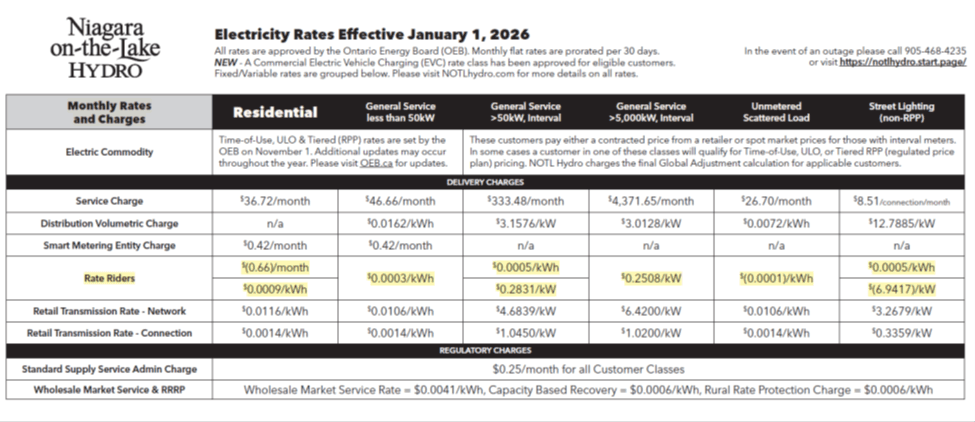
At the most elementary level, An LDC has two jobs: keep the lights on and collect the cash from customers for the entire industry. Naturally, those simple statements hide some complex and challenging processes. In the case of collections, much of that complexity comes from how NOTL Hydro is billed by the Independent Electricity System Operator (IESO) and how NOTL Hydro bills its customers. Our IESO monthly bill includes charges for the actual cost of electricity, for the cost of transmitting that electricity to NOTL and for various regulatory services. However, NOTL Hydro bills our customers based on a combination of actual costs, Regulated Price Plan (RPP) rates (i.e Time of Use), and rates for transmission and regulatory items that are set and approved annually by the OEB. The monthly difference between what NOTL Hydro charges its customers and what NOTL Hydro is charged by the IESO accumulates over time and is eventually cleared by these rate riders.
Electricity Commodity
At the basic level, this is the simplest. NOTL Hydro pays the actual hourly price and global adjustment rate. This should just be a pass-through cost. However, there are only a few consumers who actually pay the hourly and GA rates so there are some complications to this calculation.
- Most residential and small business customers pay one of the fixed RPP rates (there are a few to choose from). Though RPP rates are set as the best forecast of the combined hourly and GA rate, a forecast is never exactly the actual rate. NOTL Hydro tracks this difference and gets reimbursed or pays the IESO.
- Some larger customers will get an ICI discount on their GA rate which can be up to 100%. NOTL Hydro tracks this and gets reimbursed by the IESO.
- NOTL Hydro pays the hourly plus GA rate for power from the transmission grid but NOTL Hydro also purchases power from over a hundred small generators (mostly FIT and MicroFIT solar contracts but also a larger hydropower contract) at much higher rates. NOTL Hydro tracks this difference and gets reimbursed by the IESO.
- Residential, small business and some other customers get a large discount on their bill called the Ontario Electricity Rebate. Again, NOTL Hydro tracks this rebate and gets reimbursed by the IESO.
- Electricity is lost as it flows through transformers and along distribution lines. The total electricity sold to customers will always be less than that purchased. For NOTL Hydro this difference is estimated to be 3.74%. Any difference between actual losses and this estimated rate is tracked and recovered/repaid through a rate rider. NOTL Hydro’s loss factor has been 3.73-3.74% for over a decade limiting the actual difference to go into the rate rider.
Before smart meters, LDCs manually read meters. To do this they would have cycles in which the meters along a certain route were read and then billed. Bills thus went out on a steady basis most weeks of the month. One of the advantages of this approach is that is provides a steady cash flow to the LDC. With smart meters, this cycle billing often persisted even though the meter reading routes were no longer necessary. One of the disadvantages of this approach is that at the end of each month most customers had electricity consumption that had not been billed and must be estimated. This made the above reconciliations very difficult with a much bigger probability of error. These errors would end up being reflected in much larger rate riders.
About a decade ago, NOTL Hydro moved to monthly calendar billing for all its customers. While this had a negative impact on the timing of our cash flow, it substantially improved the reconciliation processes and resulted in much lower rate riders and rate fluctuations for our customers.
Regulatory Charges
There are a number of regulatory charges included in electricity bills. The biggest one is the Wholesale Market Services Charge (WMS) which is $0.0047 per kwh in 2026. This rate is set by the OEB for all LDCs so is the same across the province. It is a catch-all for a number of different charges on NOTL Hydro’s monthly bill from the IESO. The past few years have seen a large variance between the OEB approved rate and the actual charges from the IESO. This difference must be recaptured in the rate riders.
Transmission Rates
There are two steps to creating the OEB approved rates included on customer bills. First, the OEB sets Uniform Transmission Rates (UTRs) for the province. These are the rates are based on the highest level of demand (kW) during the month and are how NOTL Hydro is charged by the IESO and how Hydro One and other transmitters are paid. Second, NOTL Hydro uses the UTRs and the previous years demand to calculate what its customer rates will be. These are approved by the OEB and for residential and small business customers are based on the total consumption during the month (kwh).
As the basis of calculation of how NOTL Hydro is charged (kW) and how NOTL Hydro charges most of its customers (kwh) and as actual consumption will always be different than the forecast used to calculate the rates, there will always be a difference between NOTL Hydro’s transmission costs and revenues. This difference is recovered/repaid with the rate rider.
Cost Recoveries
All of the causes of rate riders above relate to recovering or repaying the difference between the revenue and costs of the LDC related to its role as the cash collection agency for the industry. There are two cases in which the OEB will allow certain LDC operational costs to be recovered through a rate rider. The first case is the excess costs from highly unusual weather events such as ice or wind storms. The LDC can request to recover these as part of its annual rate filing. The second case are costs incurred by the LDC for new programs established by the Province of Ontario. An example is the rarely used Green Button initiative that all LDCs are required to participate in and which was costly to establish. The LDC can request recovery of these costs as part of its Cost of Service application that is done every five years. Both these requests can be challenged and must be approved by the OEB.