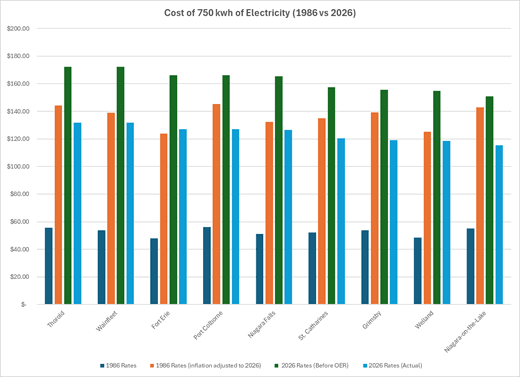
The chart above shows a comparison of 1986 rates (actual and adjusted for inflation) and 2026 rates (before the Ontario Electricity Rebate (OER) and after) for a residential customer in various Niagara municipalities consuming 750 kwh in a month. The inflation rate adjustment used is from the Bank of Canada and is 258.86%. The 2026 Ontario Electricity Rebate is 23.5%.
There are a few takeaways from the chart:
- The 2026 cost of electricity as seen by customers (light blue) is usually lower than the 1986 cost after adjusting for inflation (orange). This is only possible due the Ontario government subsidies of $8.5 billion of which $5.5 billion is the OER and $3 billion is removing the impact of the Green Energy Act.
- The real cost of electricity (green), which is before the OER is applied, has risen faster than the rate of inflation over the past 40 years. Even so, the chart makes it appear that electricity inflation has been only slightly higher than general inflation. The real 2026 rates still include the subsidy of around $3 billion as the excess costs of the Green Energy Act are being paid for with tax revenues. Otherwise, the real 2026 rates would be over 10% higher.
- In 1986, the average residential consumption was closer to 1,000 kwh rather than the 750 kwh used on average today. This change is due to two factors: the average household is smaller today than in 1986, which reduces electricity consumption, and most appliances, lights and other electricity using objects are significantly more energy efficient. Offsetting this is the significant higher number of objects using electricity in the average household today in our internet driven digital world. We therefore need less electricity to get the “value” we want from the electricity. 1986 rates would be one-third higher if we adjusted for this increase in “value”.
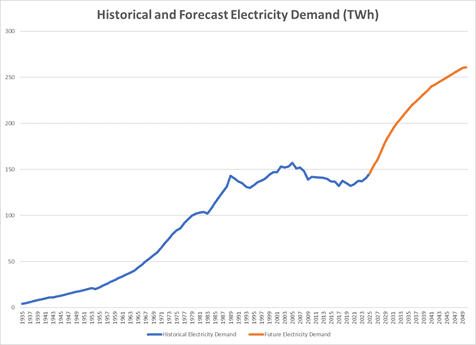
- Total consumption in Ontario was 120 TWh in 1986 versus 145.6 TWh in 2025; a 21% increase. Consumption growth has been largely stagnant over the past 40 years and is only now starting to increase.
- There have been two significant changes to the electricity supply over the past 40 years. The first was the removal of the coal plants in the early 2000’s. The second was the introduction of renewable energy in a more systematic way: originally as the overpriced Green Energy Act and more recently as part of competitive processes. Both of these would have added to the increase in the cost of electricity as would the ongoing refurbishments to the nuclear power plants.
- In 1986, Niagara-on-the-Lake had one of the higher electricity rates in the Niagara Region. In 2026, Niagara-on-the-Lake has the lowest electricity rates in the Niagara Region.