Electricity Industry Trends

Winter is the time for conferences in the electricity industry.  The other seasons are much busier with capital projects and customer jobs.

Listening to senior electricity executives from across Canada and the United States at some conferences, there are three main themes that all are discussing.

Artificial Intelligence (AI)

This should be no surprise as it appears to be the dominant theme across all industries.  And as with every industry, the question is what will be the impact of AI on the industry.  Will it be an enabler helping create better services and lower costs, will it result in job losses and/or will it create threats whereby new entrants can take sales with alternative models?  Nobody really knows the answers at this time but everyone is convinced AI will have an impact.

My own view is that AI offers a lot of promise to the electricity industry in terms of improving performance, it should not lead to job losses unless short-sighted actions are taken and it is not a threat to the industry. 

The electricity industry is full of data.  The amount of data being created is growing exponentially with new generations of smart meters, with SCADA systems and with more and more smart grid devices.  This data is not being fully utilized due to both its immensity and due to the fine margins of error needed to be overcome to make the data useful.  AI offers the potential to overcome these handicaps.  This includes managing the sheer volume of data and analyzing it on a real time basis.  With this analysis, electricity utilities like NOTL Hydro will be able to identify weaknesses in their systems so as to reduce outages, respond quicker to reduce outage times and make adjustments to reduce line losses.  This will not happen overnight but the potential is there and electricity utilities are moving in this direction.

AI also offers the potential to make the customer experience better…or worse.  AI, used in a customer-centric manner, could be used to provide CSRs with information quicker so as to assist customers, to enable customers to utilize automated services if they so choose and to create more online capabilities.  Unfortunately, there will be the temptation for utility management to use AI simply to reduce costs by reducing the communication options available to customers.  This will only make their experience worse.  History has shown that providing customers with options to suit their needs actually results in the least cost service; customers like the low-cost automated channels when these meet their needs but need other options when they do not.  Hopefully, AI will be used in the more customer-friendly fashion.

Finally, AI is not a threat to the electricity industry.  AI needs electricity to operate so instead the industry is a beneficiary of AI.  There were fears at one point of the so-called “death spiral”.  Customers would go off-grid and use distributed energy resources (DERs) instead.  As each customer left the largely fixed costs of the industry get spread over fewer customers, increasing their costs and driving them to DERs.  AI could make this a more likely scenario by improving the capabilities of DERs.  However, the “death spiral” has not happened where there are properly managed utilities.  A properly managed electricity utility still has lower costs, better reliability and more trust than DERs.  The only places where the “death spiral” has occurred is in places where corruption and insecurity are rampant and the electricity industry does not properly function.

Growth

Most electricity utilities are seeing growth that they have not seen for years or decades.  In fact, since the recession of 2008 the general trend has been either negative growth or very slow growth.  The change is due to the growth in data centres, re-industrialization and electrification.  This is affecting different electricity utilities in different ways. 

Data centres, whether for AI, crypto currencies or general cloud computing, have been the biggest driver of electricity growth but are very site specific.  Some electricity utilities will therefor see lots of this growth while others may have none.  The size and varying electricity use characteristics of data centres also creates risks and challenges for electricity utilities and system operators including the potential lost revenue if they close, how they respond or not to price fluctuations, whether they have back-up generation, how they come back online after an outage and what the impact of so much load in one place is on the local grid.  The electricity industry is grappling with these challenges. 

Reindustrialization is also somewhat site specific but brings a different challenge.  Data centres can generally go where the electricity is available.  Reindustrialized businesses tend to not be as flexible location-wise, so the challenge becomes getting them the electricity they need in a timely and cost-effective manner.  You can see these challenges with some of the EV related businesses being set up in Ontario as well as with the greenhouse industry in Ontario.  The electricity loads of these businesses are larger than normal, though not of data centre scale, and they expect their electricity requirements to be met on the same timelines as their construction and other set-up needs.  The electricity industry is not currently used to working on these timelines.

Electrification is the easiest to manage as the growth is highly dispersed just like existing electricity use.  The primary drivers are EVs with their charging requirements and heat pumps.  To-date, heat pumps have been the larger growth driver though this has not received as much publicity.  The challenge of this growth is ensuring that the grid can accommodate the higher loads in all its aspects.  This includes transformer sizing, wire sizing and feeder configuration.  The good news with electrification is that there is lots of time to make these changes and the nature of the changes required are ones electricity utilities are very familiar with.

The best part about growth is that it provides the revenue stream to pay for itself.  It should actually help lower rates.  The challenge is properly matching the costs of the needed expansion with the revenues from the growth.

System Hardening

The final trend being consistently discussed is the need for system hardening.  This is needed for two reasons. 

The first is climate change.  Whether in the form of wildfires, hurricanes, ice storms or vegetation growth, climate change is having a significant impact on the reliability of grids.  To counter this, electricity utilities are making significant investments in their systems.  This investment comes in many forms including moving parts of the system underground, upgrading parts of the system, investing in more smart grid technologies or combinations of all three. 

The second reason is the growing demands of customers.  The increased prevalence of electronics in goods, digitization, being online, streaming and working from home are all trends that mean customers are no longer as accepting of outages as was previously the case.  Even the very short outages of line faults that have been corrected with reclosers are no longer accepted.  This means that electricity utilities must make investments to try to limit these outages.

These investments will lead to higher rates.  In the case of climate change, this is just one more example of the cost of not dealing with it.  In the case of customer demand, this is the cost of receiving a better product.

The Issue with Solar Power in Ontario

Many proponents would like to see more solar power in Ontario.  I am supportive of this but solar power can only work in Ontario if it is part of a larger solution. 

When most people think of the challenge with solar power they are referring to its intermittency.  Solar generation can be significantly reduced if it is cloudy and, of course, there is no generation at night.  This is definitely an issue but it is one for which there is a solution and that is energy storage.  Energy storage in this context could be any sort of storage such as batteries, hydrogen or hydraulic.  By combining solar generation with energy storage you can create electricity generation that more closely resembles base load generation.    The issue then is no longer technical but one of cost.  Energy storage is still very expensive and the combination of solar and storage is not yet competitive, at least not in Ontario.  It may be in the future but we do not know when.

There is, however, a bigger issue with solar generation.  The intermittency challenge with solar power is not just with regards to cloudy days and nighttime; it is also with the seasons.  Solar power does not generate enough electricity in the winter in Ontario to be of use.  And while energy storage can smooth electricity supply variations during the course of a day or over a few days, it cannot smooth it between seasons.  The amount of storage that would be required is just not viable.

To illustrate, I have provided the solar production from 2.675 MW of solar generation in Niagara-on-the-Lake (NOTL) below.  As you can see, lots of power is generated in the spring, summer and fall.  However, in winter production drops to very little.  The sun is too low on the horizon to have any strength and we can go for weeks without even seeing the sun.  This is in NOTL which is one of the most southern points in Ontario.  As you get further north the winter solar performance will be even worse.

The peak summer monthly usage in NOTL is around 25 GWh a month.  To generate this in the height of summer solely with solar power we would need around 170 MW of solar generation.  That is a very large amount but it would be feasible.  10 kW on every residence would provide around 90 MW and the rest would need to be on commercial establishments and utility scale installations.  However, in December, even using a lower winter peak monthly usage of around 20 GWh, around 750 MW of solar installations would be needed.  That is just not feasible.

As mentioned at the start, I am still a fan of solar power as part of a larger solution.  One of the biggest advantages of solar power is that it can be installed in small increments.  It does not need to be a multi-million-dollar investment like hydro, gas or even wind.  Individual consumers can install their own solar to meet their needs.  The advantage of this is that the consumer is paying the capital cost; not the government or the electricity industry. 

Consumers can install their own solar generation on their own premises with a net metering agreement with their local electricity distributor.  However, if you are in a condo, an apartment or your house is not suitable for solar panels then there is no other option.  What is needed is community net metering.  Under community net metering, a large solar installation would be created in which individual customers could own a share of the output.  They would then have this output applied to their account as net metering.  There are two benefits with community net metering, the first is that any electricity consumer could participate, not just those with the ability to have a solar installation attached to their residence.  The second benefit is that building a large solar installation is much more cost effective on a kW basis.  This would be more economically efficient than the equivalent amount of individual net metering installations on multiple residents.  Unfortunately, community net metering is not currently allowed in Ontario.

OPG Rate Increase for Nuclear Power

Ontario Power Generation (OPG) submitted their application for rates for their hydroelectric and nuclear generation to the Ontario Energy Board (OEB) in December.  OPG, which is 100% owned by the Government of Ontario, has rates set by the OEB for these two types of generation rather than getting a market rate.  The idea is to provide OPG a regulated rate of return on these assets and to provide Ontario electricity consumers with this electricity at a stable cost-plus price.

In January, as interested parties worked through the submission, it hit the news that OPG was looking to almost double the price of electricity from their nuclear generation.  One MWh equals one thousand kwh so a price of $111.61 per MWh is 11.61¢ per kwh.

Proposed Price for Nuclear Electricity per MWh

 2025202620272028202920302031
Rate ($/MWh)111.61123.76213.95197.56208.56202.45222.87
% change11%73%-8%6%-3%10%

My first reaction was that this did not make sense.  I know that OPG has two big nuclear projects, the Pickering refurbishment and the small modular reactors (SMRs), but the cost of these should not affect rates until they go into service.  It would be unfair to ask today’s consumers to pay now for future generation. 

I decided to investigate further.  I came up with two explanations which are detailed below. This was not easy as the material was both voluminous and dry.  I also do not believe that OPG did themselves any favours in their presentation.  The material was presented in a very matter-of-fact manner that was very technical and, if am sure, accurate.  What it did not do was tell the “story” of why this rate increase is needed and what it means.  This then is my interpretation of the “story’ based on my review of the material.

Pickering Refurbishment

The first reason for the increase relates to the Pickering refurbishment.

OPG Output and Operating Expenses (2025-2031)

2025 Budget2026 Budget2027 Plan2028 Plan2029 Plan2030 Plan2031 Plan
Output (TWh)       
Darlington21.121.118.726.725.126.827.1
Pickering15.811.41.9
Total36.932.518.726.725.126.829.0
% change-12%-42%+30%-6%7%8%
        
Expenses ($million)       
OM&A2,044.52,118.21,863.71,756.01,917.41,856.32,153.5
Fuel255.1239.2150.9221.7223.6261.2306.1
Depreciation540.3617.7663.3708.5730.3779.8992.6
Property Tax12.213.514.014.214.514.815.0
Total2,852.12,988.62,691.92,700.52,885.72,912.13,467.2
% change5%-10%7%1%19%
        
Expenses/MWh77.392.0144.0101.1115.0108.7119.6
        
Cost of Capital1,0001,0001,091.01,144.91,150.51,198.11,679.0
Cost of Capital /MWh  27.1  30.8  58.3  42.9  45.8  44.7  57.9

In 2027, when the Pickering site is shut down for refurbishment, Ontario loses all its production.  This averaged 21 TWh from 2020-2024 or 56% of the total OPG nuclear generation.  To put this into perspective, the total demand in Ontario for 2024 was 139.4 TWh so Pickering represented 15% of the total generation needed.

However, the drop in operating expenses in the OPG nuclear operations is only 10%.  If Pickering had been closed, I would have expected the drop in operating costs to be in line with the drop in generation.  However, because it is being refurbished, most of the costs remain.  Fuel costs appear to drop proportionately but depreciation and property tax costs remain the same.  OM&A costs drop 12% but that is not proportional.  I suspect there are two reasons for this:  the plant still has to be maintained so that is a chunk of the OM&A costs that will continue and OPG continues to keep on a large number of staff in temporary roles as that is cheaper in the long run than letting them go and then rehiring and retraining when Pickering is ready to go back online.  Only some of these staff can be used in roles that can be capitalized.

I have no expertise in nuclear operations so have no idea if my assumptions are correct and, if so, if this is the best course of action that could be taken by OPG in terms of managing the refurbishment.

The table above shows the net impact of the larger decrease in nuclear generation and the smaller decrease in operating expenses on a per MWh basis.  The price required to recover the operating costs goes up considerably.  I have done the same calculation with the next biggest cost, the cost of capital required to pay interest on OPG’s debt and provide a return on equity.  These also do not decrease when the Pickering plant shuts down for refurbishment.  The cost per MWh for capital also then goes up considerably as generation falls.

The good news with this analysis is that the increase in operating costs and cost of capital per kwh is temporary.  It will go back to normal levels, adjusted for inflation and cost increases, once the refurbishment is complete and the generation goes back up to previous levels.  However, when the refurbishment is complete, the capital costs of the refurbishment will then be added to rates so the overall price of nuclear generation will stay higher.  The projected cost of power from the Pickering refurbishment is unknown but is projected to be anywhere up to $200 per MWh; about the same as the proposed rates for 2027-2031.

Capital Carrying Costs

The second reason for the increase in rates relates to the carrying cost of the capital expansion.

These are huge capital projects.  The Pickering plant refurbishment is budgeted for $26.8 billion to extend the life of the 2,200 MW units.  The first SMR at Darlington is budgeted at $7.7 billion for the first unit and $20.7 billion for all four.  Each unit is 300 MW for a total of 1,200 MW. 

These capital costs will not start to be recovered until the units are in operation.  However, for some reason the OEB does allow the interest costs associated with these projects to be recovered.  These are not insignificant and are projected to peak in 2030 at over $1.1 billion for the year.  As the revenue from nuclear generation was around $4 billion in 2025, the addition of these costs would be up to a 25% increase in the price.

Concurrent Cost Recovery ($million)

202620272028202920302031
Pickering120.6297.6479.6667.7832.0646.2
SMRs112.0214.9284.8321.2274.224.6
Total232.6512.5764.4988.91,106.2670.8

Conclusions

A few thoughts arise from this:

  • The overall logic of the price increase makes sense.  I will let others with more expertise than me argue the details over the forecast assumptions and whether OPG could do a better job in reducing costs during the shut-down.
  • I do not understand the decision as to why carrying costs of the capital expansion should be paid for by current electricity users but that seems to be based on prior decisions by the OEB.  Normal accounting practice would be to capitalize these interest costs.  The costs themselves are unavoidable.
  • Both projects are huge.  Getting them completed without cost overruns will be a huge test for OPG.  The province has a lot riding on it.  As the shareholder, they must ensure that OPG has all the best project management practices in place while not getting in the way themselves.  This would not normally be considered a strength of the provincial government.
  • It will be interesting to see how the provincial government manages the impact of this cost increase.  The 2026 increase in the cost of power resulted in the provincial subsidy going up to $8.5-9 billion.  Will they increase the subsidy dramatically again to keep the cost of electricity only going up by the rate of inflation?

Collecting on Electricity Bills

On average in Ontario, 23% of your hydro bill is kept by the Local Distribution Company (LDC).  This percentage will vary based on factors like the customer mix of the LDC and their distribution rates.  At NOTL Hydro, the average retention is 17%.

This is not a margin like in many businesses.  LDCs do not buy power from the grid and then mark up the price for resale.  LDCs sell power and all other services (transmission, regulatory charges) with zero mark-up.  Instead, LDCs have their own separate rates that are approved by the Ontario Energy Board (OEB) and these are added to the bill that goes to the customers’ monthly.  I recognize that for most customers this distinction is irrelevant as they look at the entire bill as one amount.

One of the responsibilities of the LDCs is to collect this full amount of their bills from their customers.  If these are not collected, it is the LDC that absorbs the full loss.  The LDC cannot reduce their payment for the generation, transmission and other services.

Built into the LDC rates is a provision for uncollectible accounts.  This provision is based on historical results and is negotiated with the OEB as part of the rate setting process.  Any losses above this provision is a reduction in the net income of the LDC.  LDCs therefore have two incentives to keep the loss from uncollectible accounts low.  The first is to protect against negative impacts to their own net income.  The second is to keep their rates low as the lower the provision then the lower the rates.

LDCs have three tools to assist in their collection efforts:  security deposits, disconnects and support programs. 

Security Deposits

LDCs have the right to request a deposit from any new or existing customer to protect against non-payment until the customer has established a good payment history.  The OEB has a number of strict rules around the use of security deposits.  These include:

  • Deposits are calculated using your recent electricity bills. The maximum deposit amount an electricity provider can ask for is 2.5 times your average monthly bill.
  • The security deposit must be returned once a good payment history has been established.  The good payment history is 1 year for residential customers, 3 years for small commercial customers and 7 years for large industrial customers.
  • The good payment history at another LDC, either an electricity or natural gas utility in Canada, is recognized through a reference letter from that LDC.
  • There are certain alternatives to a security deposit that apply in some cases such as participating in a pre-authorized payment plan, an equal payment plan, providing a credit check with a satisfactory credit rating or providing a letter of credit from a bank.
  • Missed payments, short payments or other payment deficiencies can result in the extension of the security deposit requirement.

Security deposits are a risk mitigation tool.  An LDC will want to have a security deposit for customers that are most at risk of non-payment.  The two types of customers with the most risk are renters and small commercial customers.  Renters can leave their property at any time and it can be expensive to try to track them down.  Small commercial businesses are also often renters and have a higher failure rate.  Residential customers that own their own homes have proven to be low risk.  Like many LDCs, NOTL Hydro no longer requires a security deposit from residential customers unless they establish a poor payment record.

The other type of customer that require special consideration are very large customers.  Though the risk of non-payment may be low, the financial ramifications from any non-payment could be high.  LDCs must determine how to manage this risk on a case-by-case basis.

Disconnects

LDCs take a number of steps to try to collect on bills once they have been issued.  These include overdue notices, disconnection notices, and phone calls to the customer before disconnection takes place.

The actual disconnection is the ultimate act by an LDC.  A disconnection is designed to do two things.  It caps the loss should the customer not pay and it puts pressure on the customer to pay as they no longer have access to this essential service.  It should be noted that disconnections also benefit all customers, not just the LDC, as they limit future rate increases from higher potential losses.  In most industries, the equivalent of a disconnection, no longer selling to a customer, is a non-issue and standard practice.  The fact that electricity is an essential service makes disconnections a more significant step.

It is this significance that has lead the OEB to create regulations around the whole disconnection process with a particular emphasis on timing and giving the customer the opportunity to pay prior to disconnection.  Most LDCs have also created their own internal processes to ensure disconnections are being made for the right reasons and in the right way.  At NOTL Hydro, the list of customers up for disconnection is approved by the President.  Despite this, there have been some disconnections that created media attention for the wrong reasons, including one that became a topic on the floor of Queen’s Park (never a good thing), that perpetuate the stereotype of the uncaring big utility.

The reality is that most LDCs are dealing with the same set of customers over and over again.  At NOTL Hydro, we are fortunate in that due to the nature of our customer demographics, our number of disconnections is quite low.  Even so, the customers usually involved in disconnections are known to NOTL Hydro staff due to their continuous behaviour.  The fact that these customers are usually reconnected within a few days is evidence that this is due to behavioural rather than financial circumstances.  The costs of reconnecting after a disconnection also outweigh any benefits from the delayed payments.

A number of years ago, Ontario instituted a ban on residential disconnections in the winter.  I am of two minds on this one.  In principle, I think the winter disconnect ban is wrong.  It rewards bad behaviour and it drives up costs and, therefore, rates.  The ad behaviour being rewarded is not paying the electricity bill.  We see customers who deliberately do not pay their bill in winter because of the disconnection ban.  This makes it more difficult for them when the bigger bill must be paid in the spring.  The higher costs come from the bigger collection efforts that are now required and from higher write-offs.  However, I also recognize the political element to the winter disconnection ban.  Shutting off an essential service like electricity during a Canadian winter does not look good and there were some abuses of this process.  At NOTL Hydro, we were always very careful with winter disconnections though that does not mean there weren’t some.

Customer Support

For customers who are not in a position to pay there are some ways we can provide support.  These include:

  • Payment arrangements can be made with the customer.  These allow the customer to pay the amount in arrears over a period rather than all at once.  While this can be helpful if a large bill has accrued, the customer is still responsible for meeting both the payment arrangement and all future invoices.  Failure to do so can lead to disconnection in the future.
  • All electric utilities in Ontario make a payment to a LEAP (Low-income Energy Assistance Program ) provider.  In Niagara-on-the-Lake the provider is Reach Out Niagara.  This is run by volunteers and they can provide financial assistance based on the criteria of the regulations.  One of the key steps in getting assistance is customers need to provide proof of their financial condition.  This only goes to the LEAP agency.  As a utility, we never want to have this information. 
  • The Government of Ontario offers a centralized customer support program called Ontario Electricity Support Program (OESP) to which anyone can apply.  The support provided, if any, is based on income and household size.
  • There are other not-for-profit organizations who can help customers in financial distress.

    If we think a customer will qualify for this assistance and benefit from it, we will direct them to these organizations.  We will not disconnect a customer while they are going through this process but it is still the customer’s responsibility to get the bill paid eventually.

    Conclusion

    Like any business, NOTL Hydro and all the electricity industry must collect on its bills in order for the business to operate.  NOTL Hydro collects recognizing this is an essential service and trying to be as fair to all customers as possible, but we must collect.

    Local Distribution Company Future Capital Requirements

    In October, the Minister of Energy and Mines released an Opinion Editorial that was printed by the National Post.  Stephen Lecce: Ontario utilities are heading towards a financial cliff   | National Post

    The Op Ed focused on potential investment challenges at municipally owned local distribution companies (LDCs) due to the expected growth in the demand for electricity over the next twenty-five years.  The Minister then appointed a panel to provide a report on a number of topics but which appeared to be largely focused on recommendations around getting investments into LDCs.

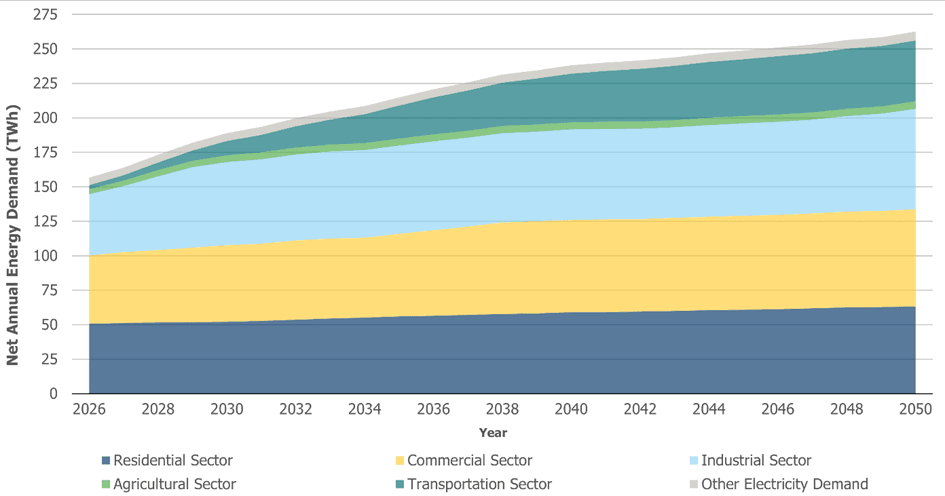
    Driving this concern is a forecast by the IESO of a 75% growth in the demand for electricity by 2050 as shown in the graph below.

    However, growth in electricity demand does not necessarily lead to a correlated growth in the investment requirements of LDCs.  I have no concerns with, and would welcome, enhanced opportunities for investments into LDCs.  Whether they are needed or not would be up to the LDCs themselves and their current owners to determine.  For the rest of this blog I would like to analyze this LDC investment requirement a little deeper and then posit an alternative possibility for the Minister’s concern.

    The IESO identified a number of factors driving the increase in the demand for electricity.  I have listed a number of them below.  The categories are of my making.

    Electricity Demand FactorConnection Investment Attribute
    Mining and processingSteel electrification (electric arc furnaces)Data centres  Very localized with significant specialized connection costs and requirements
    Industrial production Greenhouses  A mix of widespread and localized with varying connection requirements
    Residential and commercial electrification (heat pumps)Transportation electrification (EVs)  Widespread but largely using existing connections
    Population growth  Widespread and new connections

    The first category above are potential very large electricity users but that will only be in specific locations.  Mines and mineral processing facilities tend to be located in very rural areas so will require special purpose connections.  Their demand requirements also mean they will likely be connected to the transmission grid.  Steel facilities are also few in number and will need special connections.  Algoma Steel needed a new transmission line to service it when it switched to an electric arc furnace.  Data centres can go anywhere but their needs are so large that the any connection issues will be at the transmission level.  I talked to one broker for data centres and he indicated a minimum size requirement of 100 MW.  Even if data centres are distribution-connected, the high cost issues about getting them connected will all be transmission related.  In short, these are big drivers of the growth in electricity demand but are unlikely to have much of an impact on LDC investment requirements.  Where they do, it will be in one-off situations that can be managed separately.

    The electrification of heating and transportation are also expected to be big drivers of the increased demand for electricity.  However, there are two reasons while the impact of these two electricity uses will not be considerable on the investment needs of LDCs.  The first is that the vast majority of the customers that will be using these technologies are already connected.  There is very little in the way of connection work for the LDCs.  What may be needed is upgraded infrastructure to manage the higher demand from these customers.  This could include larger transformers and increased wire sizing.  This brings us to the second reason why the impact on the investment needs will be low.  The impact of this transition will take place over the full twenty-five years.  Generally, residents and businesses will only transition to EVs and heat pumps when they need a new vehicle or a new HVAC system.  Given this time horizon, the investments needed by the LDCs should be very manageable.

    Population growth will also drive up demand as this leads to new housing, new businesses and new connections.  However, the forecasts for population growth are no different, if not less, than what they have been for the past few decades so this should not really be an issue from an investment perspective.

    I skipped industrial production and greenhouses as these do have the potential to require significant investments by the LDCs.  I was at a conference recently where a Niagara industrial customer (unfortunately not in Niagara-on-the-Lake) talked about needing 5 MW in the near future.  In Niagara-on-the-Lake, we have seen the growth in demand for electricity from greenhouses, though nothing like what is happening around Leamington.  The electricity requirements of the new plants related to EVs have been well documented.  However, when you talk to the management of LDCs that have been impacted by these loads, the issue is not the investments in the distribution grid required to serve these loads, the issue is the transmission connections.  The investment constraints are to install new transmission stations or new transmission-grade connecting lines.  The current rules already provide scope for these types of investments by third parties.

    Two other factors to consider with regards to LDC investments needed to manage growth.  One, which I have mentioned, is that these investments can be made over much of the 25 year time horizon.  They do need to be made in advance, so require active planning, but they do not need to be made all at once.  The other factor is that growth in demand creates revenue streams.  These investments will be largely self-financing.  As long as the upfront capital is there, and I have demonstrated that this is less than is being argued, then there should be no issue.

    There are two other demands for investments by LDCs that do not create their own revenue stream.  The first is DERs.  More and more customers are installing DERs for their income or to offset their cost of energy.  These installations create challenges for LDCs in their local grid management.  LDCs receive little revenue from these DERs but have the expense of the grid management.

    The second, and bigger of the two,  is the demand for improved reliability by all customers.  The digitization of many aspects of daily living is substantially increasing the impacts of outages and reducing customer’s tolerance for them.  LDCs must invest in smarter grids and grid strengthening to meet these demands. 

    The investments for both these demands are ones that can be done over time.  Most LDCs have already begun to make these investments so are well on their way to managing them without being too stretched financially.

    In summary, I believe the increased demand the IESO is forecasting will not create an undue burden on the investment requirements of LDCs.  It will require significantly more generation, which the Province is proactively engaged in, and significantly more transmission.  I have often argued that it is the transmission aspect that concerns me more in terms of the Province’s ability to meet this growth in demand.

    While I have argued that the future investment requirements of LDCs should be manageable, this will depend on their ability to borrow.  One of the biggest factors affecting any company’s ability to borrow is its existing debt load.  A way to measure this is the debt:equity ratio.  This compares the amount of debt in a company to its equity.  Using this measure also allows for comparisons of LDCs of different sizes. 

    The following are the debt:equity ratios of the five largest municipally owned LDCs plus Hydro One per the 2024 OEB Yearbook.

    LDC (ranked by size)Debt:equity ratio
    Hydro One1.99
    Toronto Hydro1.26
    Alectra1.31
    Hydro Ottawa1.88
    Enova0.55
    Elexicon1.62

    The average debt:equity ratio for the Ontario LDC industry is 1.44.  If Hydro One is removed, as a publicly traded company their access to investment capital is different, the average industry ratio falls to around 1.2.  Four of the five largest municipally owned LDCs have debt:equity ratios above the industry average.  By comparison, NOTL Hydro’s debt:equity ratio is 0.64 and the average of an industry association of smaller LDCs is 0.95.

    There are two possible, complementary, explanations for this difference in the debt profiles between the larger and smaller LDCs.  One is that size is a benefit when it comes to managing debt as there are move avenues for borrowing available and a higher debt ratio can be managed.  I do not dispute this.  The other is that the shareholders and Boards of these larger LDCs have provided direction, possibly by the dividend policy, that has resulted in the higher ratios.  The news that both Toronto Hydro and Elexicon have recently amended their dividend policy would appear to bear this out.  At NOTL Hydro, and at many other smaller LDCs, the direction from the Boards and Shareholders has been to keep debt low so that the funds will be readily available if needed.

    Maybe the issue is less one of onerous future capital investment requirements but one of LDCs having appropriate financial policies to fund higher, but still manageable, investment requirements.

    Time-of-Use Global Adjustment

    The Province of Ontario recently floated the idea of allowing some customers to be charged a variable global adjustment charge instead of the current fixed charge.

    To explain.  Ontario does not have a true market for setting the price of electricity.  It has a partial market that covers some of the costs of generating electricity.  The rest is covered by a charge known as global adjustment (GA).  Some months the GA can be over 80% of the total cost of generation.  Residential and small commercial customers are charged a variety of Regulated Price Plan (RPP) set rates.  RPP rates average out to be close to the hourly price plus the GA.  All other customers must pay the actual hourly rate plus the actual GA.  The GA is set at a fixed price per kwh that is the same for every hour in the month.  Larger industrial customers can participate in the Industrial Conservation Initiative (ICI) that reduces the GA based on the ability of these customers to reduce their electricity usage at certain times.

    The idea being floated is that for those customers who do not participate in the ICI and are not eligible for the RPP, they could now opt to have a GA that is preset and varies based on the time of day.  The theory is that they could save money by adjusting when they use electricity.

    This concept has been posted on the Ontario Regulatory Registry which is a forum on which the Government posts regulations it is considering and invites feedback.  Based on this feedback, the Government can then decide if it wants to make any changes, to proceed with the regulations or to just drop them.

    I want to acknowledge and gives kudos to the thinking behind this regulation.  I have long argued that the flat rate GA is a problem.  This is trying to address that.  For this reason, I support it.

    There are two problems with this regulation.  The first and biggest is that it is treating a symptom and not the cause.  The real problem is the very existence of the GA.  If we had a true market price that covered the entire cost of generation then we would not have this issue.  As it is, more and more complexity is being created to overcome the issues being created by the GA.  The first level of complexity is the GA itself.  Industrial customers do not know their true cost of power until well after the end of the month.  The IESO provides estimates but these can be very different from the actual final price.  Then there is the ICI which pushes some of the cost of power from industrial customers to all other customers.  And now we will have a variable by time-of-day GA that will be set once a year so could be much higher or lower than the actual GA.  We are trying to mimic an actual market.

    The second problem with this regulation is that the uptake is likely to be small.  For many industrial customers, the cost of electricity is not high enough to warrant changing their production schedules to take advantage of any pricing mechanism.  For those whom it makes financial sense to make these adjustments, the ICI offers much larger and more tangible savings.  The ICI offers real reductions in the cost of electricity while this regulation only offers savings from arbitraging the price of electricity across different points of time.  Therefore, the only potential users of this option will be industrial customers not big enough for the ICI, for whom electricity is material and who can make the adjustments to the timing of their processes to realize the potential savings. 

    I support this regulation as it is better than not having it.  But I would much rather they had a true market price and did away with the global adjustment.  Then all the complexities of playing with the application of the global adjustment, like this regulation, would no longer be needed.

    There is another option.  Almost all the generation in Ontario has a set price of some sort or other.  The IESO market does not determine the revenue for most generation but rather the split between the hourly price and the GA.  One the customer side, all residential and small commercial customers already have set prices and this would allow larger commercial customers to have a set price for the GA component.  It would not be a big step to move back to having the entire market have a set annual price and no more market.  As we have smart meters, the full price could be set with hourly and seasonal variations similar to what is proposed here. This option would reduce some of the unnecessary costs and provide more certainty.  I prefer a market as in the long run they deliver the best price and choice signals but a market needs both time and confidence to work.  It has had neither in Ontario.  This alternative is not a good option; but it would be more honest and better than the convoluted mess we have now.

    Jimmy Lai

    Most readers of this blog will have heard that Jimmy Lai was recently convicted by the Government of China on a variety of trumped-up charges.  I am not turning this into a geo-political blog, I am raising this because there is a very strong connection between Jimmy Lai and Niagara-on-the-Lake and because there are some important reminders for the electricity industry.

    For anyone not familiar with him, Jimmy Lai is a 78-year-old business mogul based in Hong Kong.  One of his holdings is Apple Daily which was the last pro-democracy newspaper to operate in Hong Kong.  He may also be connected to some of the pro-democracy activities in Hong Kong which have been shut down by the Government of China.  It is due to this that the Government of China has jailed and now convicted him.  It should be noted that Jimmy Lai had lots of opportunities to leave Hong Kong, and certainly the means, but chose to stay.

    Another of his holdings is Lais Hotel Properties Limited (Lais).  Lais owns a number of upscale hotels and restaurants in Niagara-on-the-Lake including the Pillar and Post Inn, Queen’s Landing and the Prince of Wales Hotel.  Jimmy Lai was intimately involved in the management of Lais.  For many years the business was run by his sister, Si Wai Lai, who continues to live in Niagara-on-the-Lake.

    Last month, the G7 met in Niagara-on-the-Lake.  Many locals and visitors, including members of Jimmy Lai’s extended family and the Lord Mayor of Niagara-on-the-Lake, held a rally calling for his release.  There are lots of people who have much more knowledge and insight into Jimmy Lai and Lais so I will not try to go any deeper other than to say we support any discussions that our government, or other free countries’ governments, have with the Government of China to seek his release under terms that are acceptable to Mr. Lai. 

    What I will relate is one of the dealings we had with Lais as their electricity provider.  In 2019, the Government of Ontario introduced the Ontario Electricity Rebate (OER) that provided a discount on the electricity bill for residents and small businesses.  Some consultants discovered a loophole with the OER; if a hotel claimed they had someone living full time at the hotel they could claim the rebate.  That loophole has since been closed but for a while the consultants brought this to hotels across Ontario.  Some hotels in Niagara-on-the-Lake took advantage of this discount.  Lais refused to do so.  That said something to me about their integrity.

    There is a more important lesson for the electricity industry in Ontario.  Jimmy Lai was convicted because he got on the wrong side of the totalitarian regime that currently governs China.  The electricity industry in Ontario, like most industries, is going through some upheaval due to the actions of the current administration in the United States.  As a result, the Government of Ontario is encouraging, and mandating where possible, a Buy Canadian policy.  I support this as per my blog https://www.notlhydro.com/buying-canadian-electricity/ .  However, we need to ensure we maintain perspective.  As bad as things are with the administration south of the border and however much we want to react to the threats, let’s not do so by buying from and supporting a country that is so much worse.  Buying Canadian is a good idea.  Buying Chinese instead of American is not.

    One final note on this topic.  The electricity industry in Ontario and Canada has always maintained very high standards in terms of the equipment used.  This is mostly driven by the environment in which our equipment operates but also by the Canadian mentality of prudence.  Cheaper is not better if it fails more and has to be replaced quicker.  As a result, the equipment used on the distribution grids tends to be from North American or European manufacturers as they meet these standards.  This is certainly the case at NOTL Hydro and will continue to be the case.

    System Planning

    One aspect of our business we are always engaged in is system planning.  The vast majority of this relates to our own system here in Niagara-on-the-Lake but we do also provide input to the planning of the larger transmission system.

    There are multiple objectives for the system planning.  These include:

    • Keeping rates low.  We do not want to invest unnecessarily and drive rates up.
    • Having redundancy.  We want to ensure that no matter what happens we can keep the power on as much as possible.
    • Keeping outages short.  Creating as much flexibility in the system as possible so as to prevent or shorten outages.

    When NOTL Hydro was first created in its current form in the early 2000’s, the biggest challenge was reliability.  There were too many outages stemming from the connections to the grid.  The emphasis of the early system planning was upgrading these connections.  The net result was the purchasing of one station and the building of another.  NOTL Hydro is now in the fortunate position of being one of two municipal electricity distributors that owns the stations that provides its entire load from the grid.

    The next focus was on rates.  Prior to the creation of NOTL Hydro, the rates in Niagara-on-the-Lake were some of the highest.  Investments were carefully managed over the next ten years so that the rates became one of the lowest.  This was not done by “harvesting” the assets.  Harvesting means using the assets but not reinvesting.  Instead, new investments were limited to what was necessary, which was generally the ongoing voltage conversion projects.  If you do not keep investing in a system then you allow it to age and your problems and the costs to fix them will be that much worse in the future.

    It should be noted that during this time there was very little growth in demand.  There were no large new loads and the load savings from conservation were offsetting any natural growth.

    The next focus, between 2015-2020, was on redundancy.  NOTL Hydro owned the two stations but neither could support the full load of the system at peak times.  Both stations were expanded so that either can now support the full load of the system with lots of capacity for future growth.  This considerably reduces the risk of a major outage.

    Today, there are two focusses with the system planning.  The first is on creating flexibility in the system so as to reduce the impact of outages.  One reason for this focus is the demands of customers.  Customers are becoming less and less tolerant of outages as more aspects of our lives become digitized and the impact of outages becomes more significant.  The second reason is the development and improvement of smart grid devices such as switches and reclosers that make this flexibility possible.  NOTL Hydro has been investing in these switches for a number of years and has plans to accelerate these investments over the next few years.  Two examples of the benefits of these investments:  we are now able to switch power between our two stations in an automated fashion and, depending on the location and nature of an outage, we are now able to reduce the impact of that outage by up to 90% by switching the feeder lines

    The second focus is on “hardening” the system.  We are seeing more and more growth in the NOTL Hydro system, especially from larger new loads such as greenhouses, hotels and larger retail outlets.  As noted above we have plenty of capacity to support this growth but sometimes there are challenges ensuring that we have full redundancy at some spots in the system.  This hardening does not usually involve expanding the system but rather upgrading the assets in the field so that they can handle larger loads.  Some of this hardening will be large projects such as replacing blocks of poles and lines while others will be small projects like replacing individual items on some poles.

    Focus does not mean exclusive.  We continue to be very cognizant of our rates as we want to keep them as some of the lowest.  We also continue to invest in the regular system upgrades.  The voltage conversion projects continue on the Firelanes and in the Old Town with the expectation that the entire voltage conversion project will be completed within 10 years.  Focus does, however, mean prioritization.  Every year and even during a year we evaluate where our investments will add the most value and plan accordingly. 

    System planning is always done with an eye to the future.  We have room for growth at both our stations and are taking steps now to facilitate that growth should it be needed.  Similar planning is being done with the feeder lines to ensure this future capacity is available throughout the Town as needed.

    Finally, NOTL Hydro participates in the regional planning for the Niagara area performed by the Independent Electricity System Operator (IESO).  Our system and needs are small compared to what exists across Ontario but Niagara-on-the-Lake does have a voice at the table.

    Growth in Electricity Demand

    Earlier this year, the Independent Electricity System Operator (IESO), released a planning forecast of a growth in demand for electricity of 75% by 2050.  The Government of Ontario has reacted to this with a largely pro-nuclear plan for increasing electricity generation in Ontario.  I would like to dive into both of these a little deeper to explore what they may mean.

    Growth Forecast

    75% by 2050 sounds like a huge increase.  However, it sounds bigger than it really is.  The following chart shows the IESO forecast (orange line) built upon previous actual demand (blue line).  As you can see, the forecast growth is not that much different than what Ontario experienced in the 1960’s, 1970’s and 1980’s.  In fact, if I move the IESO forecast to starting in 1989 (green line), it does not look unrealistic.  The IESO is forecasting that the growth in electricity demand will return to what it was prior to 1990. 

    The IESO has built its demand forecast looking at trends in a number of electricity demand sectors.  I will look at these below.  But there may be another big picture factor at play.  1990 was also around the start of the globalization of trade.  This was the beginning of the massive shift of manufacturing to lower cost Asia; especially China.  The loss of electricity demand from this shift, as well as onoing efficiency improvements, kept demand flat for 35 years.  That era is coming to an end now and the forecast reflects the reshoring of production.  I am not saying that the manufacturing of the 1980’s is coming back.  It does not work that way.  Just like the drivers of electricity demand or technologies in the 1980’s was different than those in the 1960’s, the drivers of electricity demand in the 2020’s and 2030’s will be the technologies of these decades.  What has changed is that these technologies driving electricity demand are being used back in North America.

    A big technology driving growth in electricity demand is data centres; particularly for artificial intelligence (AI).  There is a lot of hype about this right now leading some to wonder how real it all will be.  Is there an AI driven market bubble, are the capabilities of AI overstated and is the likely demand for electricity overstated?  Likely yes in all three cases.  However, that does not mean that AI is still not a valuable tool for which there will be demand which in turn will mean much more electricity.  The growth in electricity demand from data centres will still be very real, it is just a question of how much growth.

    Another big driver will be the technologies driving the need to address climate change.  These include electric vehicles, heat pumps, batteries for storage, hydrogen, carbon storage and a host of others.  There are two reasons why the impact of these on driving electricity demand will be very real.  The first is that climate change itself is very real and we have to address it.  The second is that these technologies are generally better than what they are replacing.  For example, automobile executives will tell you that they still expect EVs to be the future.  They know this because they can see the reaction of their customers that switch to EVs.  What they do not know and what scares them is the timing of the switch as their sales depend on getting that right.  This is the case with most of these climate change technologies.  The price point may not be there yet (battery storage), or the infrastructure to support the technology (hydrogen) may not be there yet but the technology is compelling.

    Industrial demand will also drive electricity demand.  How big a driver this will be is hard to estimate.  There is no doubt that newer industrial processes require more electricity such as arc furnaces, 3D printing, chemical processing and data management.  What is not known is how of this will be located in Canada and Ontario.  There is no doubt the talent to manage these technologies is here.  The question is more whether the investment capital and the investment climate will make this happen.

    Agriculture will also be a driver of growing electricity demand.  We see this here in Niagara-on-the-Lake.  More and more products are being grown using greenhouses and many of these require light and heat that electricity can best supply.  I expect this demand to continue as the technology is improving making greenhouse grown crops very competitive.

    Government Reaction

    The Government of Ontario has reacted to these forecasts by betting big on nuclear energy.  These include the investments in small modular reactors (SMRs) at Darington, the refurbishment of the Pickering Reactor to further extend its life, the continued refurbishments at Darlington and the new Bruce C power plant at the Bruce Power site.

    The reasons for the investment in nuclear are clear:

    • Nuclear power is baseload power.  This is important as many of the new demands for electricity are either 24/7 or have electricity demand requirements that are not very flexible.  Baseload power meets these requirements.
    • Ontario has the workforce and experience to make nuclear energy viable.  Both Bruce Power and Ontario Power Generation are experienced operators and builders of nuclear power sites.  This experience is critical.
    • Nuclear power creates lots of high paying jobs and requires highly skilled trades. 
    • Expanded hydro power is not really an option.  Unlike our bordering provinces of Quebec and Manitoba, Ontario does not have extensive options for developing new hydro power.  Hydro power is also baseload power.
    • Nuclear power is emissions free.  No matter what one’s views of climate change policies are, the reality is that the need for emissions reductions will only grow. 
    • Wind and solar power are both intermittent and are not sources of electricity in which Ontario has a competitive advantage.  Wind and solar power can become baseload power if they are matched with electricity storage.  However, this combination is still not competitive, especially in Ontario.
    • The Ontario Government needs to send the signal that it is serious about ensuring there will be sufficient electricity in Ontario.  This is required to reassure investors and residents (electors).  From the Government perspective, overbuilding and having too much electricity, with its associated costs, is a much lower risk than underbuilding and not having enough.

    There are, however, three big risks with this strategy.

    1. In order for nuclear power to be cost competitive, the new installations must be built at close to budget.  The nuclear industry is famous for going over budgets by factors of 2-10 times.  This must not be allowed.  The Government is relying on the recent experience at Darlington to avoid this but that is only once experience, is not yet finished and involved refurbishing a known technology.  The budgets must be rigorously prepared and analyzed before any go-ahead is given and the construction must then stick to the budget.  This will not be easy.
    • Ontario must hope that the combination of solar power and electricity storage does not become so cost competitive that nuclear power cannot compete.  Were this to happen, much of the demand for electricity could move to these more cost competitive locations.  There is not much the Government of Ontario can do about this risk.
    • A final risk is that this will continue with the electricity sector in Ontario fully controlled by the Government of Ontario.  This creates a number of secondary risks.  These include:
      • The risk that the Government bodies responsible for managing these assets and projects lose sight of basic cost/benefit analysis and their responsibility to the ratepayer.  This was one of the factors that led to the dissolution of the old Ontario Hydro.
      • The risk of ongoing political interference, the promotion of pet projects and the resulting impacts on costs.  I remember a discussion with a former Ontario Hydro President and there was no shortage of these incidents.
      • The risk of over-regulation.  Governments use regulation to try direct industries in the way they want.  If there is little private sector involvement, then there will be little push back.  This can be seen currently.

    The IESO forecast and the Government of Ontario response has created a calculated risk in the billions of dollars.  There are a lot of good reasons for this but there is much that can go wrong.  The ongoing political management of this will require both discipline and restraint.

    PULSE and Consolidation

    PULSE

    Last month the Minister of Energy and Mines announced the formation of a panel to review the electricity distribution sector and make recommendations.  The panel is called the Panel for Utility Leadership and Service Excellence (PULSE).  The areas of focus for the panel include:

    1. Operational performance and customer service
    2. Financing gaps for critical infrastructure investments
    3. Sustainable investment in municipally owned utilities
    4. Ownership, governance and investment models for municipally owned utilities
    5. Cost reductions through shared services
    6. Connection timelines
    7. Grid modernization

    There are some interesting features about this panel.

    1. Prior to the announcement of the panel, the Minister released an Opinion Editorial that was printed by the National Post.  The Op Ed focused on potential investment challenges at municipally owned utilities.  This is very unusual.
    2. The panel was given a very short timeline of 100 days.  There will be no hearings and the panel is to rely on previously published reports as well as submissions which are due in December.
    3. I would consider the panel deep in knowledge but not broad in experience.  Three of the four panelists have backgrounds with either Alectra or Toronto Hydro; the two largest municipally owned utilities.

    Most knowledgeable people I talk to believe these features are an indication that the Minister has a clear objective and that the panel is a means to this end.  Most also believe that the objective is related to allowing more private investment into the municipal utility sector.  Why the panel is needed is unclear.  It could be to support tax discussions with the Federal Government or to provide support for what they feel may be an unpopular decision. 

    One of the peculiarities of municipally owned electricity distributors is that all of their taxes are paid to the provincial government.  Taxes are calculated just like any business but instead of payments to both the federal and provincial governments, it all goes to the provincial government.  Once private sector ownership crosses 10%, this changes and the tax payments go to both governments like a normal business.  There are also potential capital tax implications at this point which are known as a departure tax.  This tax issue has helped restrict private investment into municipally owned utilities.

    I do not know if dealing with this particular issue is the ultimate objective.  It makes sense as both the op ed and the PULSE announcement included much discussion of the need for more investment in municipally owned utilities due to electrification.  If this is the case, I have no issue with it.  There are a number of positives for increasing private investment in municipally owned utilities.  The only caveat is that it must be voluntary.  Not all the municipally owned utilities will need or want this investment.  So as long as they continue to exceed reliability and service standards, which I predict they will, they should be allowed to continue as being fully owned by the municipality.  One of the negatives of increased private investment is likely to be higher rates.

    Consolidation

    One of the byproducts of creating uncertainty is people start fearing the worst.  For municipally owned utilities, the fear is that they will be forced to consolidate.  This fear is not unfounded.  The provincial government has consistently promoted consolidation in its publications, has legislated numerous tax policies to promote consolidation and had required the utilities to discuss what they are doing about consolidation in their rate filings. 

    I do not believe that this is the objective.  If it is, it will be a big mistake.  The best possible evidence as to why this would be a mistake was just published.

    Alectra is the largest municipally owned utility in Ontario.  It has over 1 million customers and includes the large municipalities of Markham, Vaughan, Richmond Hill, Mississauga, Brampton, Hamilton, St. Catharines and Guelph plus a number of others.  The whole argument for consolidation is that efficiencies from scale should result in lower rates for customers.  If any utility should achieve these efficiencies, it should be Alectra. 

    The Ontario Energy Board (OEB), in a further promotion of consolidation, allows consolidated utilities 10 years in which they do not have to file a full cost of service rate application.  The rates basically just increase with inflation during this period.  The idea is to allow the utility to keep the benefits of consolidation for ten years in higher earnings before returning it to their customers in lower rates.

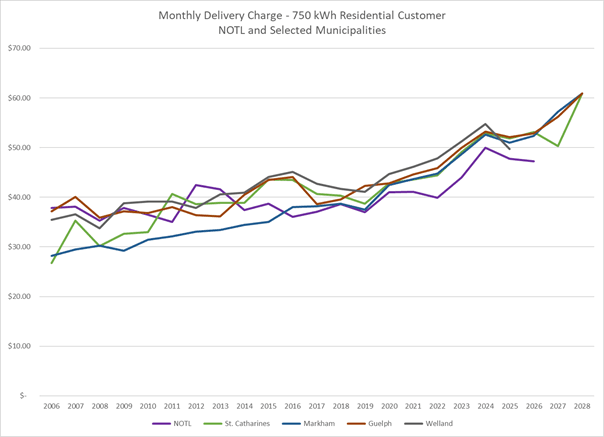
    The following chart shows the rates since 2006 for three of the Alectra municipalities (Markham, St. Catharines and Guelph) and two much smaller Niagara utilities (Niagara-on-the-Lake and Welland).  Alectra just filed their 10 year cost of service and are proposing to harmonize their rates in 2028.  I have shown their rates including their proposed 2026, 2027 and 2028 rates.  For Welland, I only have their actual rates to 2025 and for NOTL I have included the 2026 proposed rates. 

    The chart shows that in 2025, the rates were lower in both Welland and NOTL.   It also shows that there will be no permanent rate reduction for Alectra customers.  St. Catharine’s customers get a one-year reduction in 2027 but return to the higher harmonized rates in 2028.

    As mentioned, if any customer should be seeing the benefits of consolidation, it should be a customer of Alectra.

    I should note that the rates from 2026-2028 for both Alectra and NOTL Hydro are proposed and still need to be approved.  In the case of Alectra, the process is still at an early stage and there are likely some adjustments down in the proposed rates.  This will not change the underlying argument.

    The Alectra rate filing does have a section in which it describes all the savings that have been realized from the consolidation.  I do not question these.  However, from experience I know that there are other pressures increasing costs.  These include higher salaries for management now that they are managing bigger teams, increased layers of management and increased costs to manage a large and widespread business.  These costs are not insignificant, arise naturally over time, and can easily offset the actual savings. 

    I am not disparaging Alectra with these observations.  I am a customer of theirs in St. Catharines and have few complaints.  The complaints I do hear about Alectra are typical of those of any large organization.  That is, they have lots of good and knowledgeable staff, but their processes can also be bureaucratic, slow and impersonal.

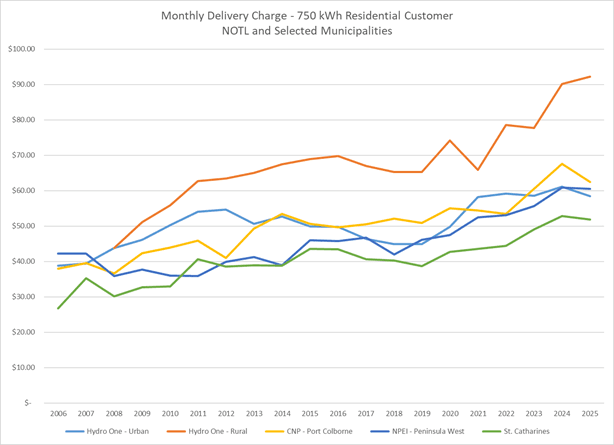
    Alectra’s rates also compare favourably to some other consolidators like Hydro One, CNP and NPEI as shown in the chart below.  I used the St. Catharines rates as the proxy for Alectra.

    Finally, I have nothing against mergers and acquisitions.  A shareholder should always have the right to sell their investments.  There are some mergers taking place right now that make perfect sense and many of the current municipally owned utilities are the products of mergers.  What I am against is this notion that further consolidation is needed to lower rates and improve service quality.  The facts show that this is not the case.  Can we not instead celebrate the benefits of having different approaches, be rid of this notion that one solution is the best for all our customers and remove all the challenges the provincial government tries to make to encourage consolidation.