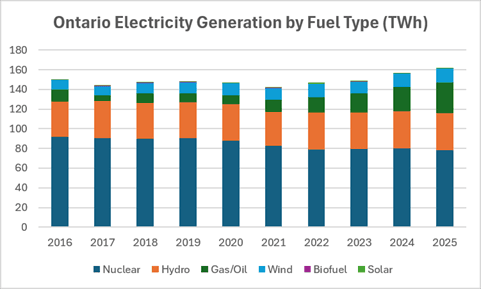
The Independent Electricity System Operator (IESO) publishes the mix of sources of electricity used to supply Ontario each year. The chart above shows this mix for the last ten years. A few comments on this:
- Demand for electricity is now growing. This can be seen on the chart. Demand had been declining since 2008. The IESO forecasts demand to grow by 65% by 2050 due to electrification, data centre demands and industrial requirements. We can likely expect continued growth in electricity demand for the next few years.
- The chart only tracks generation that is directly connected to the transmission grid. These are the large generators. There is also generation that is directly connected to the distribution grids that are not included in the chart. This is mainly small solar generation (rooftop and small ground-based) but also includes some small hydro, wind and biofuel. On a capacity basis this is less than 10% of total generation but in terms of actual generation it will likely be only 1-3%. Including distribution connected generation would be more accurate but will not affect the general analysis.
- I have not included storage in the chart. The IESO included it as a source of electricity for the first time in 2025 but it was only 0.2 TWh. I am also not sure how storage can be considered a source of electricity. Storage does not generate electricity but rather discharges when it can be used. Storage is very valuable when matched with generation that is intermittent or only available at certain times, like solar, as it can shift this generation to the times it is needed. I am assuming the IESO is reflecting the generation that was shifted and is not double counting. Either way, it is not currently large enough to impact any analysis.
- Solar generation barely shows on the chart. Most solar is distribution connected but is still only a small amount of the total generation. For instance, NOTL has a very high number of solar installations for its size but these still only generate less than 2% of total consumption.
- Biofuel generation is very limited and that is not likely to change.
- Wind power is more significant as the individual installations can be very large. Like solar, wind power technology continues to improve. The more recent developments have tended to be for offshore wind power as these can be even larger. Ontario is not adjacent to any oceans but is adjacent to most of the Great Lakes. Wind power installations in the Great Lakes are currently prohibited so that may be a missed opportunity. One of the key attributes of wind is that some sites are better than others in terms of when the wind blows and how consistent it is. This analysis is important in determining how well the wind power will integrate with the rest of the grid.
- Nuclear power is the source of most electricity in Ontario. It is also a baseload source which means it is steady and continuous for the full 24 hours a day. In an ideal world you have a cheap baseload power for most of the power with other easily adjustable sources of electricity to handle the variations throughout the day. The amount of electricity from nuclear power is now lower than it was previously. Most of the nuclear facilities are being taken offline in a planned manner over time to allow for refurbishment. So far these refurbishments have been on time and on budget. This is critical as the refurbished nuclear power will be the primary source of baseload electricity until new nuclear plants can be built.
- Hydro power is the second source of baseload power. It is also the cheapest source of electricity in Ontario and the original source of electricity in Ontario. That is why we are NOTL Hydro. The amount of hydro electricity in Ontario has not changed much over the past ten years as there are no new hydro plants of any size coming into production and there are limited opportunities.
- The final source of electricity in Ontario is the most controversial…natural gas. The use of gas has risen from 4% of supply in 2017 to almost 20% in 2025. This is unfortunate. Gas is the most flexible source of supply so is needed to manage the fluctuations in demand over the course of the day. Coal used to provide this service but it has been phased out and natural gas creates much lower emissions. There is no substitute that is as effective and cost efficient. Storage will be in the future but is not there yet. It appears that natural gas is being used to offset the decline in nuclear power due to the refurbishments and to support the increase in demand. I can understand the attraction of using natural gas. The plants are already in existence so the only cost is the fuel which is relatively cheap.
With the use of carbon-based sources of electricity approaching 20%, Ontario is losing some of its bragging rights about having clean energy. Climate change is a real and growing issue. I do note that Ontario still have a better mix than almost all the US states and the IESO is also clearly trying to improve its clean power mix with recent projects to purchase both new supply and capacity (storage). It would be nice if more could be done to get the use of natural gas back down below 10% to the total sources of electricity.
I do not pretend to have the answer but some ideas include:
- See if the cost per kwh of large scale solar and storage installations could match natural has in cost. This has been in the case in some sunnier jurisdictions but it is unclear if that could be the case here.
- Allow community solar. This will allow the creation of solar installations at scale that are paid for by customers.
- Allow offshore wind in locations where it makes sense. These locations will be a combination of having the right wind attributes and having good nearby connection points to manage costs.
- Ease some of the restrictions that currently prevent the installation of small hydro plants.
- Continue to be more aggressive in looking for natural gas alternatives.