There are two concepts I would like to discuss today and an important link between them.
Local distribution companies (LDCs) like NOTL Hydro are responsible for distributing power to all the customers in its service territory. This includes power that comes from the transmission grid and power that is locally generated. LDCs have no say in who gets to generate the power and what the cost of the power is. That is all managed by the Independent Electricity System Operator (IESO). Even the old FIT and MicroFIT generators, though they are managed by the LDCs, are governed by contracts with the IESO. If someone wants to generate power and sell the output today, the only way they can is with a contract with the IESO or with a net generation contract with their LDC. A net generation contract only allows you to get credits for the power you put on the grid for future usage, it does not allow you to get paid for the power.
Many LDCs would like to see the concept of a Distribution System Operator (DSO) introduced. If you ask ten different LDCs what a DSO is you will likely get ten different responses. A DSO could be anything from an LDC being able to turn on and off some sources of electricity to an LDC operating a mini market just like the IESO does for all of Ontario. Many of the larger LDCs are promoting the DSO concept and the Ontario Energy Board (OEB) is studying it which means nothing will happen until the provincial government dictates otherwise.
I am most interested in the DSO concept from the perspective of an LDC being able to contract for some local electricity supply. This is where solar power comes in.
The cost of solar power has been steadily and continuously declining. At first this was a new technology, and the cost decline was from improvements in the technology. Once the technology was largely standardized the cost decline came from massive improvements in the manufacturing processes, largely in China. Costs declines were then driven by standardizations of the installation processes. We are now moving to a new wave of technology improvements with new developments such as layered tandem solar and using perovskite materials instead of silicon.
Solar power is now the lowest cost source of a kwh of electricity and this will more and more be the case. However, there are issues with solar power which I described in my January 28, 2026 blog https://www.notlhydro.com/the-issue-with-solar-power-in-ontario/. We will thus still need nuclear and hydro power to be the baseload generation for electricity in Ontario. Solar, though, is rapidly becoming the best source of generation for the peak loads above the baseload power. This is where the DSO comes in.
There are a number of reasons why it may be best to have the LDCs purchasing some of this peak load electricity. These include:
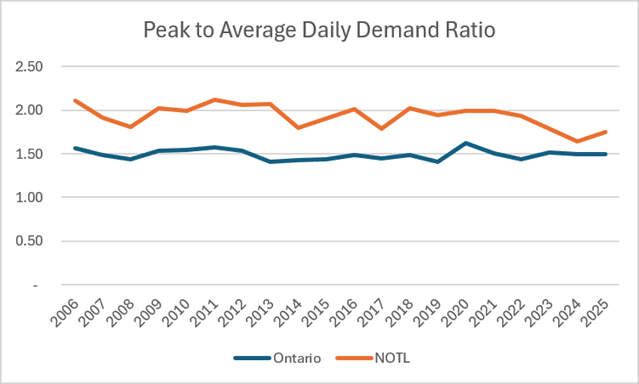
- Peak demand varies across the province. For instance, the following chart shows the ratio of peak demand to average demand in NOTL vs Ontario as a whole. As can be seen, the ratio is higher in NOTL; likely due to its more southernly location but also due to the nature of the customer base in NOTL. The relationship of peak demand will vary based on location and customer base for all LDCs. The local LDC will have the best understanding of this and can integrate this knowledge into any power purchasing.
- Solar installations can vary in size from a few kw to many MW. The IESO has the expertise and resources to manage the large grid connected generation projects of many MW. They do not have this expertise for smaller generators. The local LDCs will have this capability.
- One of the key issues to be addressed prior to going forward with a DSO will be risk management and who takes on the risk should the LDC lose on purchasing contracts. The lower cost of solar power helps mitigate this risk.
There would still be many details to work out with the DSO concept including how the power purchases get integrated into the commodity, how customers are protected against any risky transactions by the LDCs and whether the LDCs can themselves own generation.
The cost of electricity is rising significantly. Taking advantage of solar power for peak loads is one good way to help keep the cost down and a DSO is a good way to utilize this solar power in the most efficient manner.